
What Is Schema Markup? A Complete Guide to Structured Data for SEO
Why Schema Markup Matters in Modern SEO
Search engine optimisation (SEO) has evolved far beyond keywords and backlinks. Today, context and meaning play a crucial role in how search engines rank and display content. This is where schema markup becomes essential.
Schema markup helps search engines like Google, Bing, and Yahoo understand not just what your content says, but what it means. When implemented correctly, it can unlock rich search results that stand out visually, driving higher click-through rates and better user engagement.
In this guide, you’ll learn:
- What schema markup is
- How structured data works
- Types of schema markup
- Benefits for SEO
- Real-world examples
- How to implement schema markup step by step
What Is Schema Markup?
Schema markup is a type of structured data added to a website’s HTML that helps search engines understand content more clearly. It enables enhanced search results, such as rich snippets, star ratings, FAQs, and product details, improving visibility and click-through rates in search engines.
Schema markup is a semantic vocabulary of tags (microdata) that you add to your website’s HTML to help search engines interpret your content more accurately.
It was created through a collaborative effort by Google, Bing, Yahoo, and Yandex and is maintained at Schema.org.
In simple terms:
- Humans read content visually
- Search engines read content structurally
- Schema markup bridges that gap
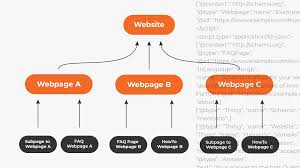
For example, schema markup can tell search engines:
- A number is a price
- A string of text is a review
- A date is an event start time
- A name refers to an organisation or a person
How Schema Markup Works
Search engines crawl your website’s HTML. When schema markup is present, it provides additional context in a structured format that machines can easily process.
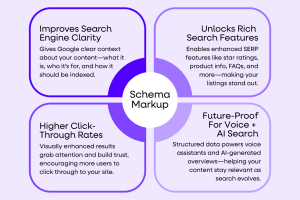
Schema does not directly boost rankings, but it:
- Improves search result appearance
- Enhances relevance signals
- Increases click-through rate (CTR)
- Supports voice search and AI results
Common Schema Formats
- JSON-LD (Recommended by Google)
- Microdata
- RDFa
JSON-LD is the most widely used because it’s clean, easy to manage, and does not interfere with on-page content.
What Is Structured Data?
Structured data is organised information that follows a predefined format, making it easier for search engines to interpret.
Schema markup is one type of structured data, specifically designed for search engines.
Example:
-
Unstructured: “John reviewed this product and gave it five stars.”
-
Structured: Reviewer = John, Rating = 5, Review Type = Product Review
Types of Schema Markup (With Examples)
Schema.org supports hundreds of schema types, but only some are commonly used for SEO.

1. Article Schema
Used for:
- Blog posts
- News articles
- Editorial content
Benefits:
- Improved appearance in Google News
- Better eligibility for Top Stories
2. FAQ Schema
Used for:
-
Frequently Asked Questions pages
Benefits:
- Expanded SERP listings
- Higher CTR
- Voice search compatibility
3. Product Schema
Used for:
-
E-commerce product pages
Includes:
- Price
- Availability
- Reviews
- Ratings
4. Review & Rating Schema
Used for:
- Products
- Services
- Local businesses
Benefits:
- Star ratings in search results
- Increased trust and visibility
5. Local Business Schema
Used for:
- Physical locations
- Service providers
Includes:
- Business name
- Address
- Opening hours
- Contact details
6. Event Schema
Used for:
- Webinars
- Conferences
- Live events
Includes:
- Date
- Location
- Ticket info
7. Breadcrumb Schema
Used for:
-
Site navigation clarity
Benefits:
- Cleaner URLs in SERPs
- Better UX signals
Benefits of Schema Markup for SEO

1. Enhanced Search Results (Rich Snippets)
Schema allows your listing to include:
- Star ratings
- Images
- FAQs
- Prices
These listings visually outperform standard blue links.
2. Higher Click-Through Rates (CTR)
Eye-catching results naturally attract more clicks, even if your ranking stays the same.
3. Improved Search Engine Understanding
Schema reduces ambiguity, helping search engines:
- Categorise content correctly
- Match pages to relevant queries
4. Voice Search Optimisation
Voice assistants rely heavily on structured data to answer questions accurately.
5. Better Indexing for Complex Content
Ideal for:
- Ecommerce
- Events
- Recipes
- Courses
- SaaS platforms
Schema Markup vs Rich Snippets: What’s the Difference?
| Schema Markup | Rich Snippets |
|---|---|
| Code you add to your site | Visual result in SERPs |
| Not visible to users | Visible to users |
| Enables rich results | Outcome of schema usage |
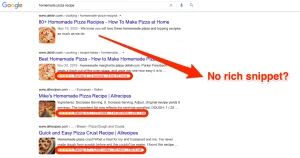
Important: Adding schema does not guarantee rich snippets. Google decides eligibility based on quality and relevance.
How to Implement Schema Markup (Step-by-Step)
Step 1: Choose the Right Schema Type
Identify what content you’re marking up:
- Blog → Article
- Product → Product
- FAQ → FAQPage
Step 2: Generate Schema Code
You can:
- Manually write JSON-LD
- Use schema generators
- Use SEO plugins (WordPress)
Step 3: Add Schema to Your Website
- Insert JSON-LD in the
<head>or before</body> - Use CMS plugins if applicable
Step 4: Test Your Schema
Use:
- Google Rich Results Test
- Schema Markup Validator
Step 5: Monitor in Google Search Console
Check:
- Enhancements report
- Errors or warnings
- Performance improvements
Common Schema Markup Mistakes to Avoid
- Adding irrelevant schema
- Marking up hidden content
- Using fake reviews or ratings
- Mixing schema types incorrectly
- Ignoring validation errors
Best Practices for Schema Markup
- Use JSON-LD
- Match schema to visible content
- Keep the schema updated
- Follow Google’s structured data guidelines
- Avoid spammy markup
Is Schema Markup Worth It?
Absolutely.
While schema markup is not a direct ranking factor, it plays a critical supporting role in SEO by improving visibility, engagement, and relevance, especially in competitive search landscapes.
With AI-driven search, voice assistants, and rich results becoming the norm, schema markup is no longer optional; it’s foundational.
Final Thoughts: Schema Markup as a Future-Proof SEO Strategy
Schema markup helps search engines understand your website the same way humans do. It enhances visibility, supports emerging search technologies, and gives your content a competitive edge.
If you’re serious about SEO in 2025 and beyond, implementing schema markup is one of the smartest technical optimisations you can make.