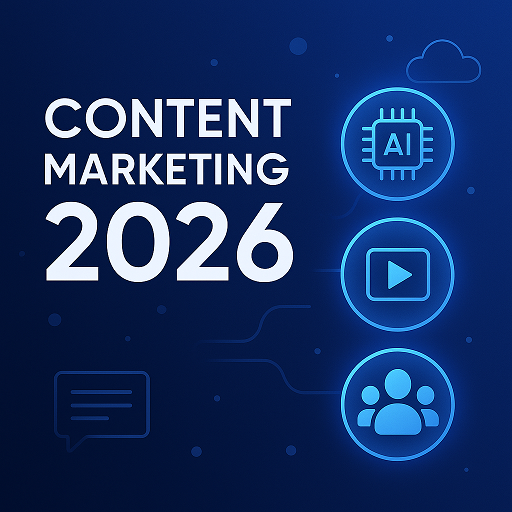
The 12 Most Important Content Marketing Trends to Watch in 2026
Content marketing isn’t just evolving, it’s accelerating.
In my career, I’ve rarely seen an industry shift this dramatically in such a short time. The forces behind this transformation are clear: AI is reshaping how content is created and discovered, while audience behaviour is redefining where and why people engage.
In this guide, I’ll break down the 12 most impactful content marketing trends for 2026 and what they actually mean for marketers trying to drive results, not just impressions.
The top content marketing trends for 2026 are:
- AI-assisted content creation.
- Original expert-led insights.
- LLM and AI search optimization.
- Multi-channel distribution.
- Product-led BOFU content.
- Short-form and searchable video.
A Quick Overview of Predicted 2026’s Biggest Content Trends
| Trend | What It Means |
|---|---|
| Original, opinion-driven content | Generic advice no longer wins; unique perspectives do |
| AI-assisted (not AI-only) creation | AI boosts speed, humans provide value |
| Multi-channel distribution | Google alone is no longer enough |
| Optimising for LLM visibility | Content must be retrievable by AI systems |
| Employee-led social content | Real people outperform brand pages |
| Product-led BOFU content | Tie content directly to revenue |
| Expanded marketer skill sets | Strategy, analytics, and product knowledge matter |
| Owned audiences (subscribers/followers) | Reduce dependency on algorithms |
| Short-form & searchable video | Video dominates attention and discovery |
| Original campaign ideas | Copying others no longer cuts through |
| AI influencers & avatars | Emerging, but trust is fragile |
| Realistic goals & timelines | Sustainable wins beat fast burnout |
Now, let’s explore each trend in detail.
1. Original Opinions Are Now a Requirement, Not a Bonus
For years, “useful” content was enough. In 2026, it isn’t.
Large language models can already answer most basic questions instantly. If your content simply repeats what’s already available, audiences, and search platforms, have little reason to engage.
The content that performs best today:
- Takes a clear stance
- Shares firsthand experience
- Includes original data, experiments, or stories
Brands that invest in expert-led insights, proprietary research, and real-world lessons are seeing stronger engagement and trust.
How to apply this trend:
- Let internal experts publish under their own names
- Interview practitioners and turn their insights into content
- Run original surveys or analyse internal data
- Publish case studies that show real outcomes, not theory
2. AI Is Standard, But How You Use It Is What Matters
AI adoption is no longer optional. Your competitors are using it, and your audience doesn’t care whether you used AI; they care whether the content is valuable.
The mistake isn’t using AI. The mistake is letting AI replace judgment, creativity, and experience.
The strongest teams use AI to:
- Speed up research and outlining
- Generate ideas and angles
- Support analysis and experimentation
But humans still:
- Shape the narrative
- Add perspective and nuance
- Ensure accuracy, tone, and originality
Best practices for AI-powered content:
- Treat AI as a collaborator, not an author
- Add lived experience and brand voice
- Fact-check and edit rigorously
- Use AI creatively (data analysis, tools, ideation, not just writing)
3. Relying on One Channel Is a Risk You Can’t Afford
If 2025 taught marketers anything, it’s this: traffic volatility is the new normal.
Algorithm changes, AI answers in SERPs, and zero-click searches have made organic traffic less predictable, even for established brands.
At the same time, audiences are actively searching elsewhere:
- AI platforms
- Social networks
- Video platforms
- Communities and newsletters
The goal in 2026 isn’t abandoning SEO; it’s reducing dependency on it.
How to diversify effectively:
- Invest in platforms where your audience already learns (LinkedIn, YouTube, Reddit, TikTok)
- Repurpose core ideas across multiple formats
- Prioritise depth and usefulness over volume
- Optimise content to appear in AI-generated answers, not just rankings
4. Large language models (LLMs) Are Becoming Discovery Engines, Not Just Answer Tools
AI platforms like ChatGPT are no longer closed ecosystems. They actively reference and link to external content, and the number of sites receiving traffic from them is growing fast.
Even when users don’t click, being cited by AI:
- Builds brand authority
- Reinforces expertise
- Influences future buying decisions
AI search behaviour is also different. Queries are longer, more conversational, and more scenario-based.
How to optimise for AI visibility:
- Answer questions clearly and early in your content
- Use structured formatting (headers, lists, summaries)
- Focus on problem-solving scenarios
- Publish original insights AI can’t synthesise elsewhere
- Write in natural, conversational language
5. Real People Are Now the Strongest Top-of-Funnel Asset
Audiences trust individuals more than logos, especially on platforms like LinkedIn.
Founders, employees, and subject-matter experts are increasingly responsible for:
- Driving awareness
- Educating audiences
- Building credibility
Employee-led content consistently outperforms brand posts in reach and engagement.
How to activate this trend:
- Encourage team members to share insights publicly
- Support founder-led storytelling
- Provide templates, training, or content prompts
- Let employees build their own professional brands
6. Product-Led Content Drives Revenue in an AI-First World
Informational content still matters, but it can’t be your entire strategy.
To convert attention into revenue, brands need product-led content that shows how their solution works in real workflows.
High-performing formats include:
- Use-case-driven tutorials
- Customer case studies
- Interactive tools and calculators
- Comparison and alternatives pages
Execution tips:
- Use real product data to tell stories
- Offer ungated tools that demonstrate value
- Answer “how do I do X with your product?” explicitly
- Tie content to middle- and bottom-of-funnel goals
7. Content Marketers Must Expand Their Skill Sets
AI is changing team structures, not eliminating the need for expertise.
The marketers who thrive in 2026 will:
- Think strategically, not just tactically
- Understand products deeply
- Measure impact beyond traffic
- Know how to guide and evaluate AI outputs
Skills to prioritise:
- Audience research and insight analysis
- Business and product strategy
- Analytics and performance measurement
- AI literacy and experimentation
8. Owned Audiences Are a Competitive Advantage
Algorithms change. Subscribers stay.
Brands that invest in email lists, newsletters, and follower communities are more resilient to traffic drops and platform shifts.
A loyal audience:
- Shares content organically
- Engages repeatedly
- Reduces reliance on paid or algorithmic reach
How to build loyalty:
- Involve your audience in content creation
- Partner with trusted industry voices
- Communicate consistently via email and social
- Be transparent about wins, failures, and lessons
9. Video Is No Longer Optional
Video now dominates:
- Social engagement
- Search visibility
- On-site experience
Short-form video, in particular, is becoming a discovery engine of its own.
Beyond awareness, video also:
- Improves dwell time
- Attracts backlinks
- Enhances SEO performance
- Supports onboarding and retention
AI tools are making video production faster, but strategy still matters.
10. Safe, Copied Campaigns No Longer Stand Out
When every brand copies the same formats, nothing feels memorable.
The campaigns that break through in 2026:
- Borrow inspiration from outside their industry
- Solve real, unmet problems
- Create experiences that can’t be easily replicated
Ways to innovate:
- Study brands beyond your niche
- Experiment early with new formats
- Build signature content experiences
- Prioritise originality over virality
11. AI Influencers Are Emerging, But Trust Is Fragile
Virtual creators and AI avatars are gaining traction across platforms.
They offer scalability and consistency, but only if brands are transparent.
Audiences quickly disengage when they feel misled.
Best practices:
- Clearly disclose AI-generated personas
- Align influencers with brand values
- Monitor trust and engagement closely
- Adjust quickly if sentiment shifts
12. Realistic Goals Are the Foundation of Sustainable Content
AI increases speed, but it doesn’t eliminate the need for:
- Planning
- Resources
- Time
Many teams fail by chasing volume instead of impact.
Avoid these mistakes:
- Unrealistic publishing schedules
- Expecting instant results
- Measuring success with vanity metrics alone
What works instead:
- Align goals with business outcomes
- Invest in quality over quantity
- Accept that content is a long-term strategy
- Match expectations to available resources
Final Thoughts: How to Stay Competitive in 2026
Content marketing in 2026 rewards brands that are:
- Flexible in distribution
- Intentional with AI
- Invested in people
- Focused on originality
- Patient with growth
AI can accelerate your efforts, but it can’t replace your perspective, experience, or credibility.
The brands that win won’t publish more content.
They’ll publish better, more human, more distinctive content consistently.
And that’s what will keep audiences coming back.
People Also Ask