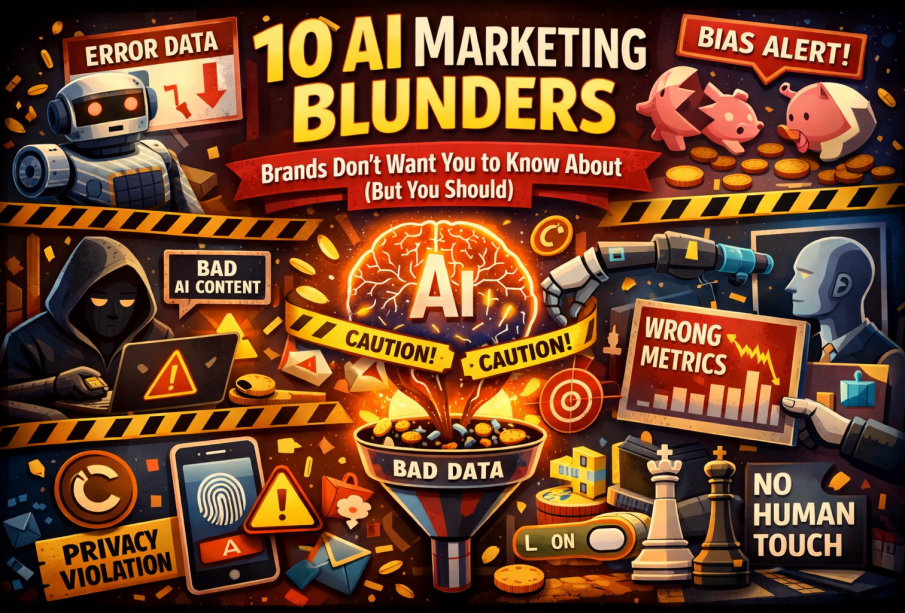
10 AI Marketing Blunders Brands Don’t Want You to Know About (But You Should)
What are the biggest AI marketing mistakes brands make?
The biggest AI marketing blunders include relying on poor data, over-automating customer experiences, ignoring bias and ethics, misusing generative AI, failing to align AI with business goals, and replacing human creativity instead of augmenting it. Avoiding these mistakes helps brands improve trust, performance, and ROI.
Introduction: The AI Marketing Gold Rush (and Its Hidden Traps)
Artificial Intelligence has transformed modern marketing. From predictive analytics and personalisation to generative content and automated media buying, AI promises faster growth, lower costs, and smarter decisions.
But here’s the uncomfortable truth: many brands are quietly failing at AI marketing.
They won’t talk about it publicly because failed AI initiatives waste budgets, damage customer trust, and sometimes spark PR disasters. Yet these mistakes are surprisingly common, even among global brands.
If you’re using (or planning to use) AI in marketing, understanding these blunders isn’t optional; it’s a competitive advantage.
Let’s expose the 10 AI marketing blunders brands don’t want you to know about, but you absolutely should.
1. Treating AI as a Magic Tool Instead of a Strategy
One of the biggest AI marketing mistakes is assuming that simply “adding AI” will fix broken marketing processes.
Many brands invest in AI tools without:
- Clear business objectives
- Defined KPIs
- A roadmap for integration
AI is not a strategy. It’s a capability.
When AI is deployed without alignment to brand goals, such as customer acquisition, retention, or lifetime value, it becomes an expensive experiment rather than a growth engine.
How to avoid it:
Start with the problem, not the tool. Define what success looks like, then choose AI solutions that directly support that outcome.
2. Feeding AI Poor or Incomplete Data
AI is only as good as the data it learns from. Yet brands routinely train marketing AI systems on:
- Outdated customer data
- Inconsistent CRM records
- Biased historical campaigns
- Siloed datasets across regions
This leads to inaccurate targeting, irrelevant recommendations, and misleading insights.
In GEO-focused marketing (local or regional campaigns), bad data can be especially damaging, causing AI to misunderstand cultural, linguistic, or geographic nuances.
How to avoid it:
Audit your data regularly. Clean, enrich, and unify datasets before deploying AI models, especially for personalisation and predictive analytics.
3. Over-Automating Customer Experiences
Automation is powerful, but over-automation kills authenticity.
Many brands use AI chatbots, automated emails, and AI-generated responses so aggressively that customers feel they’re talking to machines, not humans.
Common symptoms include:
- Robotic chatbot replies
- Over-personalised messaging that feels invasive
- AI emails triggered at inappropriate moments
This erodes brand trust instead of building it.
How to avoid it:
Use AI to assist, not replace, human interaction. Design clear hand-offs between AI and human teams, especially in high-emotion or high-value customer moments.
4. Using Generative AI Without Brand Governance
Generative AI tools like ChatGPT, Gemini, and Claude have revolutionised content creation, but many brands deploy them with zero brand governance.
The result?
- Inconsistent brand voice
- Factually incorrect content
- SEO penalties from low-quality AI content
- Legal risks from copyrighted or misleading outputs
Some brands only realise the damage after the content goes live.
How to avoid it:
Create strict AI content guidelines: tone, vocabulary, fact-checking rules, and human review processes. AI should follow your brand, never redefine it.
5. Ignoring Bias and Ethical Risks in AI Marketing
AI models learn from historical data, and history is biased.
When brands fail to address AI bias, they risk:
- Excluding minority audiences
- Reinforcing stereotypes in ad targeting
- Creating discriminatory pricing or offers
Beyond ethical concerns, this can trigger regulatory scrutiny and reputational damage, especially in regions with strict data protection laws.
How to avoid it:
Regularly audit AI outputs for bias. Involve diverse teams in model evaluation and ensure compliance with local and global regulations.
6. Chasing Personalisation Without Consent or Context
AI enables hyper-personalisation, but many brands cross the line from “relevant” to “creepy.”
Examples include:
- Referencing private user behaviour too directly
- Using inferred data, customers never knowingly shared
- Personalising messages without a clear opt-in
This is particularly risky in GEO-targeted campaigns where privacy expectations vary by region.
How to avoid it:
Practice ethical personalisation. Be transparent, respect consent, and design AI experiences that feel helpful, not invasive.
7. Replacing Human Creativity Instead of Enhancing It
Some brands try to cut costs by replacing creative teams with AI.
This often backfires.
AI can generate content quickly, but it struggles with:
- Emotional storytelling
- Cultural nuance
- Original brand ideas
- Strategic creativity
The result is generic marketing that blends into the noise.
How to avoid it:
Use AI as a creative co-pilot. Let humans define ideas and strategy while AI accelerates execution, testing, and optimisation.
8. Failing to Train Teams to Use AI Properly
Buying AI tools without training teams is like buying a plane without teaching anyone to fly.
Many marketing teams:
- Don’t understand AI limitations
- Over-trust AI recommendations
- Misinterpret predictive insights
- Use tools inconsistently across regions
This leads to poor adoption and missed ROI.
How to avoid it:
Invest in AI literacy. Train marketers to question, validate, and collaborate with AI, not blindly follow it.
9. Measuring the Wrong Metrics
AI marketing success is often measured using vanity metrics:
- Click-through rates
- Content volume
- Automation speed
These don’t always reflect real business impact.
AI may increase efficiency while decreasing brand equity or customer satisfaction, issues that surface only later.
How to avoid it:
Measure what matters: customer lifetime value, retention, conversion quality, brand trust, and long-term growth, not just short-term performance.
10. Assuming AI Will Replace Marketing Leadership
The final and most dangerous blunder: believing AI can replace human judgment.
AI doesn’t understand:
- Brand purpose
- Market disruptions
- Cultural shifts
- Ethical trade-offs
Brands that rely solely on AI decision-making risk losing strategic direction and emotional connection with customers.
How to avoid it:
AI should inform decisions, not make them alone. Strong leadership, vision, and accountability remain irreplaceable.
Why These AI Marketing Blunders Matter More Than Ever
As AI becomes mainstream, the gap between brands that use it thoughtfully and those who use it recklessly will widen.
Customers are smarter. Regulators are stricter. Search engines are evolving. And trust is now a core competitive advantage.
Avoiding these AI marketing mistakes isn’t about slowing down innovation; it’s about using AI responsibly, strategically, and human-first.
Conclusion: The Brands That Win with AI
The most successful brands don’t hide their AI use, but they don’t worship it either.
They:
- Align AI with real business goals
- Respect data, privacy, and ethics
- Balance automation with humanity
- Use AI to amplify not replace great marketing
If you learn from these blunders now, you won’t just avoid mistakes, you’ll build a smarter, more resilient marketing future.